YoDINO: Foundation Vision Backbone for YOLO
Connecting DINO foundation vision to YOLO via Meta ViTDet for efficient multi-task learning
Project Overview
Traditional computer vision systems train separate models for each individual task, wasting compute and struggling when training data is limited. YoDINO connects the rich, pre-trained visual understanding of DINO foundation models with the speed of YOLO. Using architectural principles from Meta's ViTDet, a single visual encoding of the environment can power multiple tasks simultaneously (such as object detection and segmentation). Parameter-Efficient Fine-Tuning (PEFT) is used to adapt the model quickly while keeping its foundation intact.
The Challenge
Deploying large vision foundation models into real-world applications faces practical hurdles:
- Redundant Task Processing: Running separate AI models for every single task wastes heavy computational power when one shared visual understanding could serve all of them.
- Architecture Incompatibility: Vision Transformers process images differently than standard fast detectors like YOLO, making it difficult to connect them directly without custom architectural adapters.
- Heavy Retraining Costs: Fully retraining massive foundation models is slow, expensive, and risks erasing their broad general intelligence.
The Solution & Architecture
To create an efficient, generalizable vision pipeline, I combined DINO, YOLO, and Meta's ViTDet concepts:
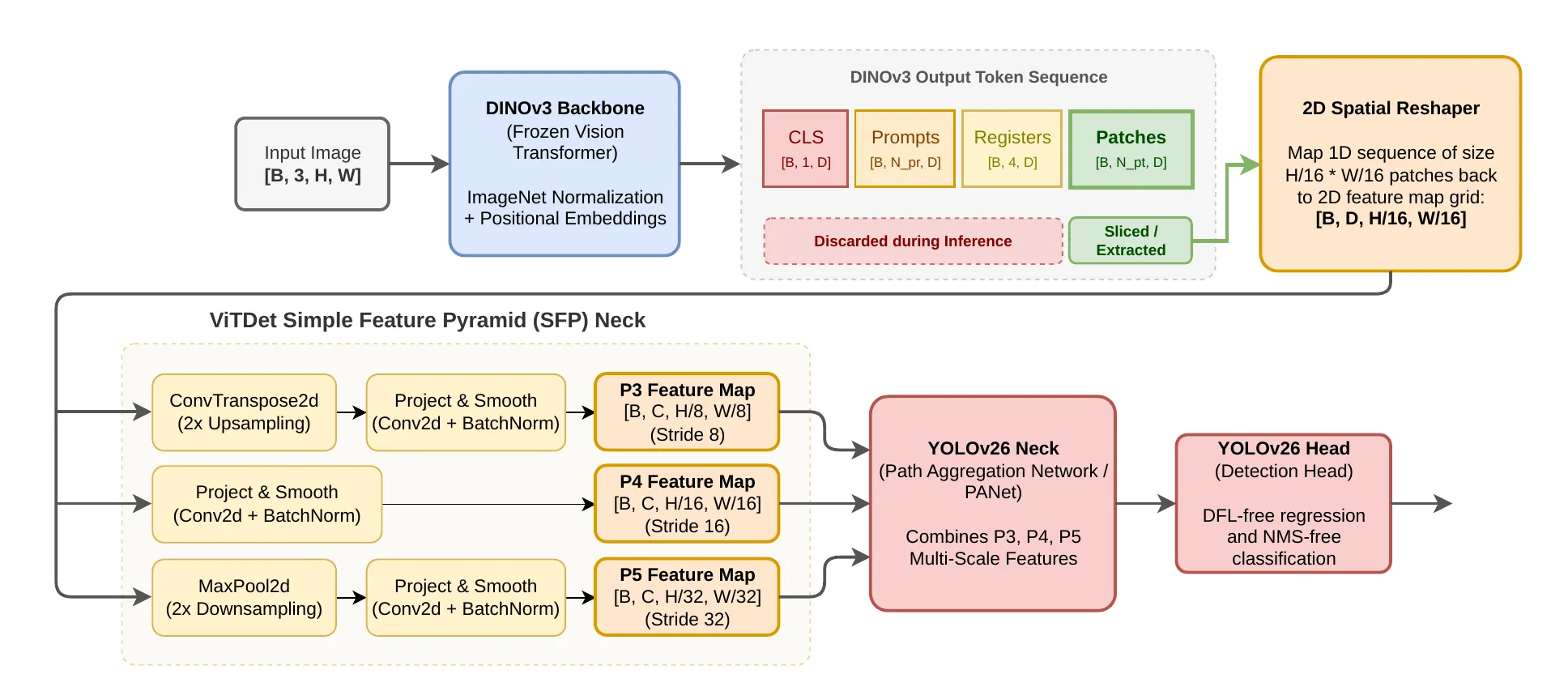
- ViTDet Bridge to YOLO: Connected the DINO backbone directly to the neck and head of YOLO using Meta's ViTDet approach, allowing YOLO to easily use rich foundation features.
- Preserving DINO for Multi-Tasking: Kept the core DINO foundation frozen so its rich visual representations can be reused across different downstream tasks simultaneously without retraining from scratch.
- Lightweight Adaptation with PEFT: Applied Parameter-Efficient Fine-Tuning (PEFT) to train less than 1% of the model's parameters, dramatically cutting training time and resource requirements while protecting the model's overall generalization.
Architecture Overview
Key Architecture Advantages
YoDINO establishes an efficient, practical approach for using foundation vision models in multi-task setups: