MoCA AI: Cognitive Impairment Screening
Parameter-efficient foundation vision tuning for early dementia and Alzheimer screening from drawing tests
Project Overview
Mild Cognitive Impairment (MCI) is a critical early stage of cognitive decline that often precedes Alzheimer's disease. Standard clinical screening relies on neuropsychological drawing tests (such as clock drawing, cube copying, and trail making). This project introduces a parameter-efficient AI framework that adapts a frozen DINOv2 vision foundation model to accurately detect cognitive impairment from patient drawings, training under 6% of total parameters while providing built-in visual explanations for clinicians.
The Challenge
Automating clinical screening from neuropsychological drawings presents unique medical and technical hurdles:
- Scarcity of Medical Training Data: Collecting large annotated clinical datasets is difficult, making heavy models with tens of millions of trainable parameters prone to severe overfitting.
- Diagnostic Ambiguity Near Boundaries: Patients near the standard Montreal Cognitive Assessment (MoCA) cutoff score of 25 show subtle, borderline drawing patterns that hard binary classification fails to capture reliably.
- The Black-Box Dilemma: Healthcare professionals require trustworthy, interpretable visual evidence explaining why a patient's drawing indicates potential impairment rather than opaque probability scores.
The Solution & Architecture
To deliver accurate, lightweight, and explainable medical screening, I developed a prompt-tuned foundation model architecture:
- Modality-Specific Prompt Tuning (PEFT): Attached three learnable prompt tokens (one for each drawing test: clock, cube, and trail) to a frozen DINOv2 backbone. This trains only 1.19 million parameters (under 6%), keeping 94%+ of the model frozen to preserve general vision intelligence.
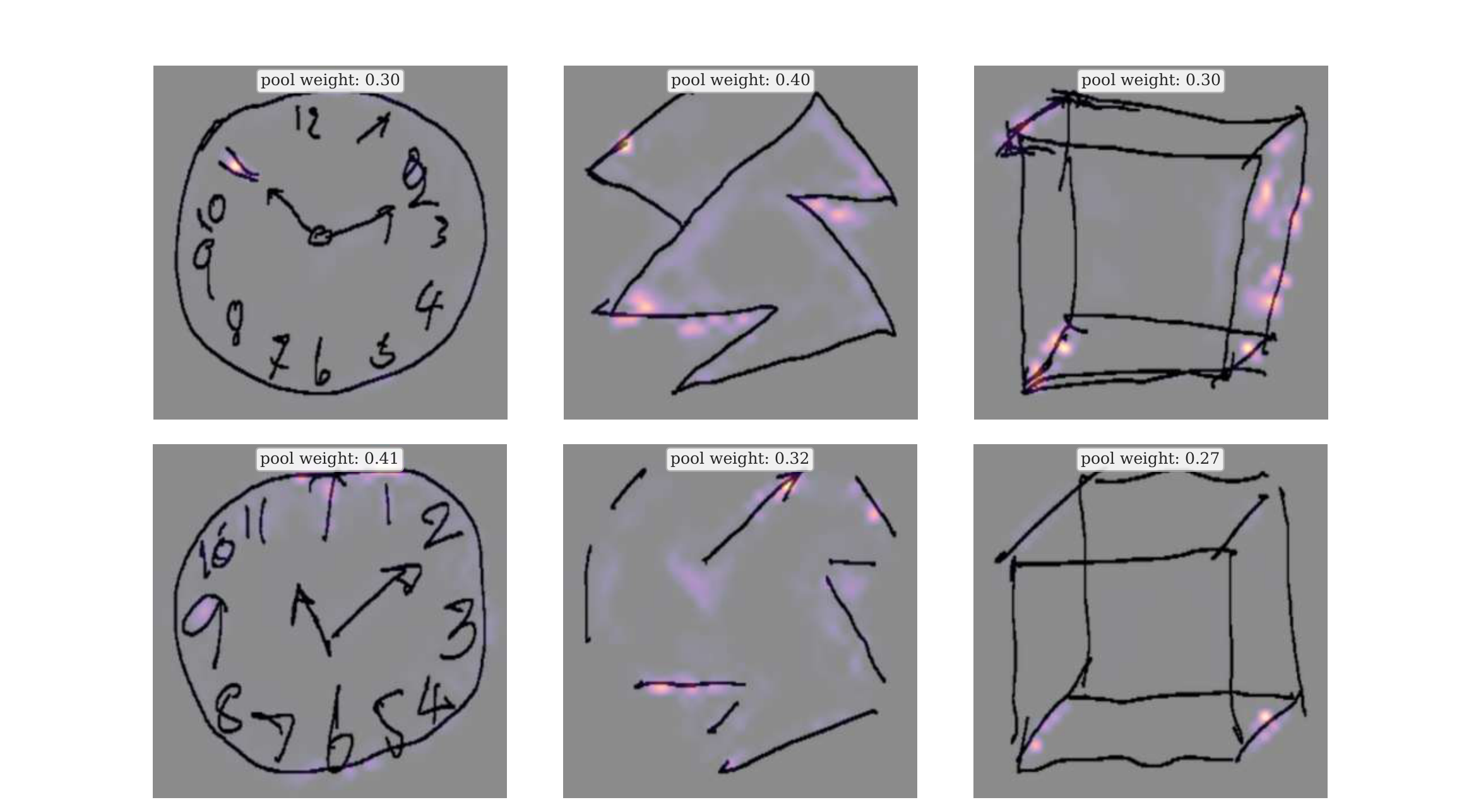
- Direct Visual Explainability: The learnable prompt tokens act as queries over the drawing patches in a shared cross-attention layer, automatically producing clear spatial attention heatmaps that show clinicians which drawing irregularities influenced the diagnosis.
- MoCA-Adapted Loss Function: Formulated a specialized loss function that incorporates continuous clinical MoCA scores into soft training targets, guiding the network smoothly through borderline cases.
Clinical Inference & Spatial Attention Heatmaps
Cross-attention maps and modality pooling weights during inference across clinical drawing tests (Clock Drawing, Trail Making, and Cube Copying), highlighting subtle cognitive impairment indicators:
Benchmark Metrics & Diagnostic Impact
Under stratified 5-fold cross-validation on clinical drawing datasets, the lightweight model outperformed the heavy reference baseline: